
From Stamplay to FMExchange 2026: Nicola Mattina returns to the FileMaker story with a question about the future of software development.
It was 2013. In Italy, a young startup was born with an ambitious idea: making it easier to build applications without having to write everything from scratch. Connect services, automate processes, and let developers focus on what they wanted to create rather than spending their time reinventing the wheel.
Its name was Stamplay.
Fast forward six years. In March 2019, news broke that Apple had acquired a small Italian startup. The story even made the pages of Il Sole 24 Ore. And yes, it was Stamplay.
Now, that name might not mean much to you today. But if you’ve spent any time in the FileMaker ecosystem, you almost certainly know what came next: Claris Connect.
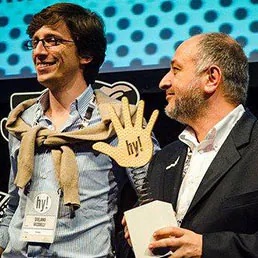
Stamplay’s technology became the foundation of Claris Connect, and one of its two founders, Giuliano Iacobelli, went on to become Vice President of Product Management at Claris. But what happened to the other founder?
He stayed in Italy, continued working on technology and innovation, supporting startups, mentoring young developers, and sharing his knowledge with anyone willing to listen. His name is Nicola Mattina, and on November 5, he’ll be joining us at FMExchange 2026 in Milan.
Not to talk about Stamplay or explain Claris Connect, but to ask a question that might be even more relevant today than the one that inspired Stamplay thirteen years ago: YOUR CODE IS NOW FREE. WHAT ARE YOU SELLING ON MONDAY?
There’s something rather amusing about this. Long before AI agents started writing code, Nicola was already working on ways to make developers spend less time writing it. Stamplay was built around a simple observation: developers were spending far too much time connecting systems, rebuilding functionality that already existed, and solving technical problems that had little to do with the actual purpose of their applications.
The idea wasn’t to replace developers. It was to give them more time to build things that mattered.
Thirteen years later, we’re having a remarkably similar conversation, except the technology has changed dramatically. AI can now generate code, build interfaces, suggest architectures and perform tasks that once required hours of development. Agentic development is pushing that boundary even further. And suddenly, the question isn’t just how much time we can save. It’s what we’re going to do with all that time.
For FileMaker developers, this is particularly interesting. We’ve spent decades explaining that FileMaker allows us to build business applications faster than traditional development tools. Speed has been one of our strongest arguments, and rightly so. But what happens when everyone else starts building software faster, too?
If writing code becomes cheaper, does that make developers less valuable? Or does it finally force us to explain what our real value has been all along?
That’s the conversation Nicola is bringing to FMExchange. And I particularly wanted him on our stage because he doesn’t come from the FileMaker community. He isn’t here to defend our favorite platform, celebrate its latest features or reassure us that everything will be fine.
He’s spent years working with startups, entrepreneurs and developers, looking at technology from the perspective of the people trying to build something useful with it.
I suspect he’ll have a few things to say about what developers should be selling when the technical work is no longer the most expensive part of the equation.
And there’s another reason his presence matters to me. We often discuss the future of FileMaker almost exclusively among ourselves. We invite experienced developers, Claris representatives and consultants who know the platform inside out. Those conversations are valuable, but occasionally we need someone who doesn’t share all our assumptions.
Someone who can look at the way we work and ask why we’re still doing certain things at all.
Nicola will open the first morning of FMExchange, immediately after our opening keynote, “FileMaker Is in Your Business. So Now What?”
It’s a deliberate choice. Before we spend two days exploring new technologies, real-world applications, AI, automation and the future of our existing systems, I want us to consider a more fundamental question: what exactly are we bringing to the table?
Because when the conference is over and we’re back at work, our clients probably won’t care how many lines of code we wrote, how many scripts an AI agent generated or how impressive our development environment has become.
They’ll care whether we solved their problem.
And perhaps that’s the most interesting connection between Stamplay in 2013 and FMExchange in 2026. The tools keep changing. The amount of work we can automate keeps growing. But the challenge of understanding what people actually need hasn’t become any easier.
So, what are you selling on Monday?