
We came to Milan to talk about survival.
Not ours, necessarily. Although, after two days of presentations, conversations, questionable amounts of coffee, and the usual event logistics, I suspect a few of us were beginning to identify rather strongly with the dinosaurs.
The theme of this year’s FileMaker Week was Surviving the Future.
And for two days, we put FileMaker, its developers, and the businesses that depend on it under the microscope.
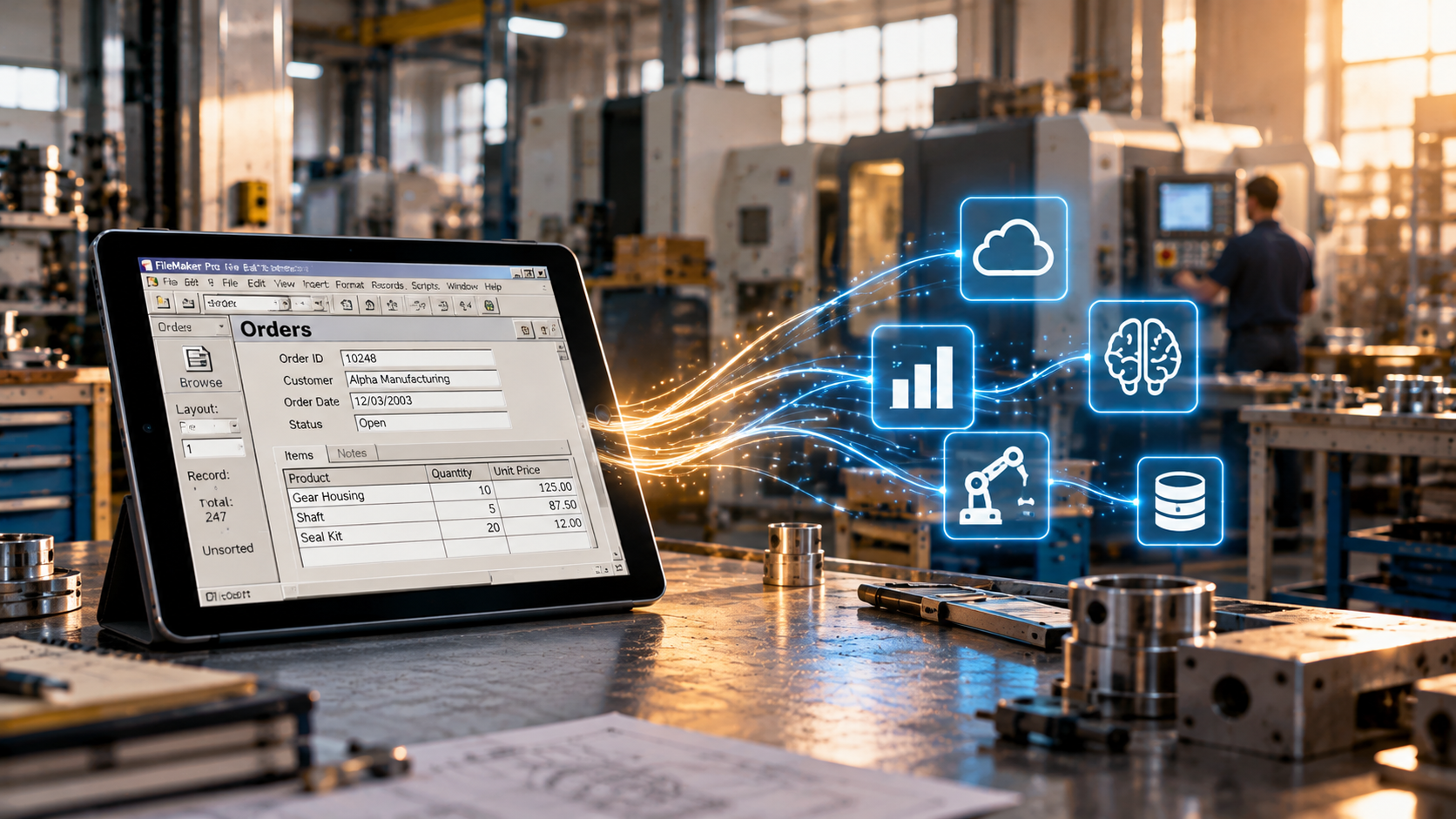
We talked about artificial intelligence, agentic development, integration, architecture, and the uncomfortable reality of applications that have been running businesses for decades.
We also talked about something we don’t discuss nearly enough: why perfectly functional software sometimes dies.
But looking back at those two days, I think the most interesting thing wasn’t any particular technology.
It was the questions we started asking.
Your code is free. What are you selling on Monday?
Nicola Mattina opened a particularly uncomfortable door with that question.
If AI makes writing code increasingly accessible, what exactly is the value of a developer?
For years, we’ve measured expertise partly by the difficulty of producing something. Knowing how to build it was valuable because most people couldn’t.
Now the boundaries are moving.
Douglas Wallis took us into agentic development for FileMaker. We explored what happens when AI starts participating in the development process rather than simply assisting with isolated tasks.
And throughout the conference, we saw increasingly concrete examples of AI working with FileMaker: semantic search, medical workflows, data access, automation, and applications that can do more than wait for someone to click a button.
The technology is fascinating.
But it raises another question.
If building becomes easier, will we finally spend more time understanding what needs to be built?
Or will we simply build the wrong things faster?
The uncomfortable business of keeping things alive
One of the things I wanted to bring to this conference was a perspective that doesn’t always get enough space at developer events.
The customer.
Not the imaginary customer in a perfectly written specification. The real one, with an organization, budgets, internal politics, changing management, conflicting priorities, and employees who don’t necessarily use software the way we imagined they would.
In my session, FileMaker Must Die, I shared real stories of FileMaker applications that disappeared, projects that failed, and solutions that never made it into production.
Not because FileMaker couldn’t do the job. Sometimes the technology wasn’t even the problem.
The reasons were far more human: expectations, trust, organizational changes, decisions made far away from the people who actually used the software, and that is a difficult thing for developers to accept.
We like technical problems because technical problems usually have technical solutions.
Human problems are considerably less cooperative.
Yet those are precisely the problems that determine whether an application survives.
John Renfrew challenged us to think about the eventual death of our applications. Albert Harum-Alvarez questioned the temptation to rebuild everything from scratch.
Two apparently opposite perspectives, but an interesting shared reality: software doesn’t exist independently of the people and organizations around it.
An application can be technically excellent and still become irrelevant.
And another can be old, imperfect, even occasionally irritating, and remain absolutely essential to the business.
The difference isn’t always in the code.
One track. One conversation. Two days.
This year we made a deliberate choice.
After experimenting with different formats in previous editions, we brought everyone into a single conversation.
One track. No competing sessions. No need to choose which speaker to miss.
I wanted people to hear perspectives they might not normally seek out.
The developer who came for AI might find themselves thinking about business strategy. The person interested in architecture might suddenly recognize a problem of organizational culture. And someone convinced that the future lies in completely new tools might discover that a decades-old FileMaker solution still has something important to teach us.
That’s where conferences become interesting to me: not when everyone agrees, but when different experiences start challenging each other.
Our AI Labs added another dimension: the opportunity to move beyond talking about possibilities and start exploring them (and to have a little fun, thanks Giulio Villani).
Of course, some of the best conversations happened outside the official program.
Over coffee, during lunch, and in those unplanned moments when someone says, “Actually, we had exactly that problem…”
Those conversations are difficult to put on a conference agenda.
They’re also one of the main reasons I keep organizing these events.
So, did we survive the future?
Apparently, yes.
But survival was never really the destination.
A system can survive for years without improving anyone’s life. A developer can keep producing software without questioning its usefulness. A business can maintain an application simply because replacing it would be painful.
Survival, by itself, isn’t much of an ambition.
And perhaps that is what these two days have clarified for me.
The interesting question isn’t whether FileMaker will survive AI, new development tools, changing business expectations, or whatever technology comes next.
It is what we choose to do with the possibilities we now have.
Can we help companies make better decisions? Can we uncover information they already possess but cannot use effectively? Can we prevent mistakes, reduce waste, and build systems that actually understand the work they are supposed to support?
Can we stop thinking exclusively about what our applications can do and start asking what difference they make?
These are not questions that belong to FileMaker alone.
They’re questions for anyone building software.
And they deserve more than another two days of talking about the latest features.
From Jurassic Milan to outer space
Which brings me to next year.
Yes, we’re doing it again.
FileMaker Week returns to Milan on October 14–16, 2027.
Two tracks, two worlds, one experience. Your own.
Three days: a new chapter, and a rather different universe.
After spending 2026 surrounded by dinosaurs, we’ve decided it’s time to look towards the stars.
Science fiction has always fascinated me, not because it predicts technology particularly well, but because it uses imagined technologies to explore very real human questions.
How do people live with the systems they create? What happens when those systems become more intelligent, more powerful, or simply more complicated than their creators expected?
Who benefits? Who decides? And what happens when things don’t go according to plan?
Those are excellent questions for the FileMaker community, too.
We already have the dates. We already have the venue. And, being constitutionally incapable of making a quiet announcement, we’ve made a trailer.
Houston, now what?
Start watching the FileMaker Week 2027 trailer:
As for the event itself, we have plenty of ideas and a whole year to challenge them, discard some, and turn the best ones into something worth travelling to Milan for.
Because I don’t want us to spend another year merely predicting what technology will do.
I’d rather talk about what we intend to do with it.
Before we leave the Jurassic Park…
An event doesn’t happen because someone books a venue and fills a schedule.
It happens because people choose to contribute.
To every speaker who brought their experience, their ideas, and sometimes their uncomfortable questions: thank you.
To Claris, our partners, sponsors, and the people who helped make this edition possible: thank you for supporting a community that isn’t afraid to challenge